The Rise of AI Agents: Why 2026 Will Be Remembered as the Year Work Changed Forever
By TechInsight
September 18, 2026
We are no longer living in the age of AI tools.
We are entering the age of AI Agents — and most people still don’t fully understand what that means.
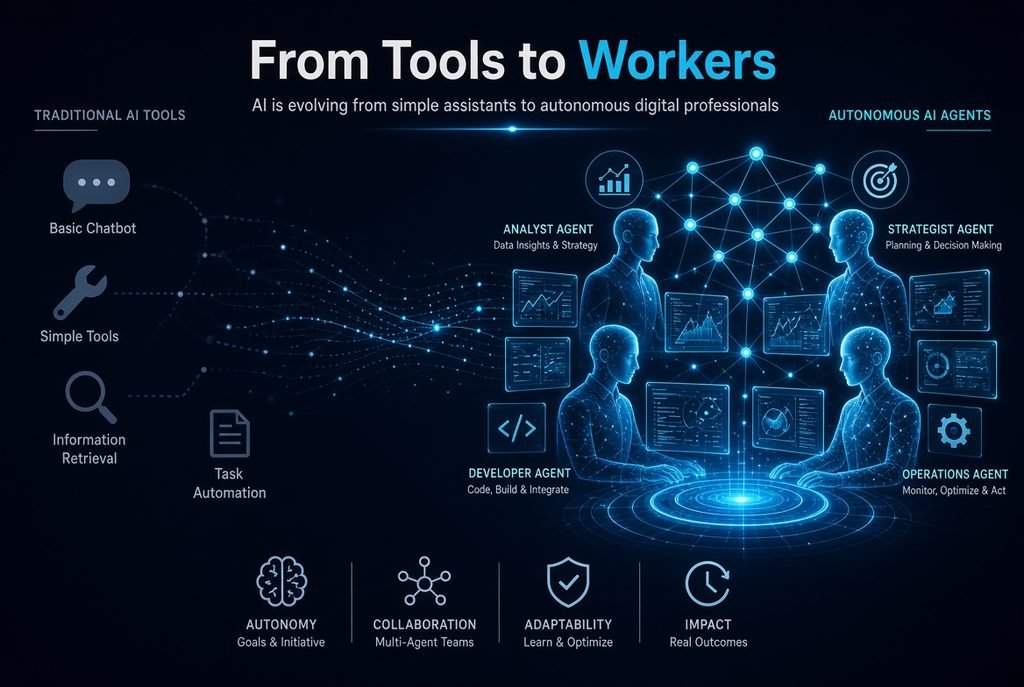
ChatGPT, Claude, Gemini and Grok were just the beginning. They answered questions. AI agents do work. They plan, execute, use tools, remember context, and complete multi-step tasks with almost no human supervision. In 2026, this shift is no longer experimental. It is becoming operational.
From Tools to Workers
The difference is fundamental.
A traditional AI model is like a very smart consultant: you ask, it answers.
An AI agent is closer to a junior employee: you give it a goal, and it figures out the steps, uses the necessary tools, checks its own work, and delivers results.
Modern agents can already:
- Browse the internet and extract structured information
- Write, test, and debug code across multiple files
- Manage emails, calendars, and research workflows
- Interact with Apish, databases, and other software systems
- Collaborate with other agents in multi-agent systems
This is not science fiction. Companies in software, finance, customer support, marketing, and research are already deploying these systems at scale.
Why This Moment Feels Different
Three forces have converged in 2026:
- Model capability has crossed a critical threshold. Reasoning models can now maintain coherent plans over long horizons.
- Tool use has become reliable enough for real work, not just demos.
- Infrastructure (memory, orchestration, evaluation) has matured enough to run agents continuously.
The result is a quiet productivity explosion. Early data from companies using agent systems shows 40–70% reductions in time spent on knowledge work that was previously done by humans. The gains are not uniform — they are concentrated among people and teams who know how to direct agents effectively.
The Uncomfortable Truth
This technology is powerful enough to create massive value, and disruptive enough to create serious dislocation.
Roles that involve research, first-draft writing, data analysis, routine coding, and process coordination are being compressed. The people who thrive are those who move from “doing the work” to “designing and supervising the work.” The gap between high-agency users of AI and passive consumers is widening faster than most expected.
There are also real risks: agents can still hallucinate, make costly mistakes, leak data, or act in unexpected ways when given too much autonomy. Security, evaluation, and human oversight remain unsolved problems at scale.
What Comes Next
The next phase is already visible: multi-agent systems. Instead of one agent doing everything, specialized agents will collaborate — one researching, one analyzing, one writing, one verifying. This mirrors how human teams work, only faster and cheaper.
By the end of 2026, the most competitive organizations will not be those with the best individual AI models. They will be those with the best systems for deploying, managing, and auditing fleets of AI agents.
The Real Question
This is not another tech trend.