Introduction
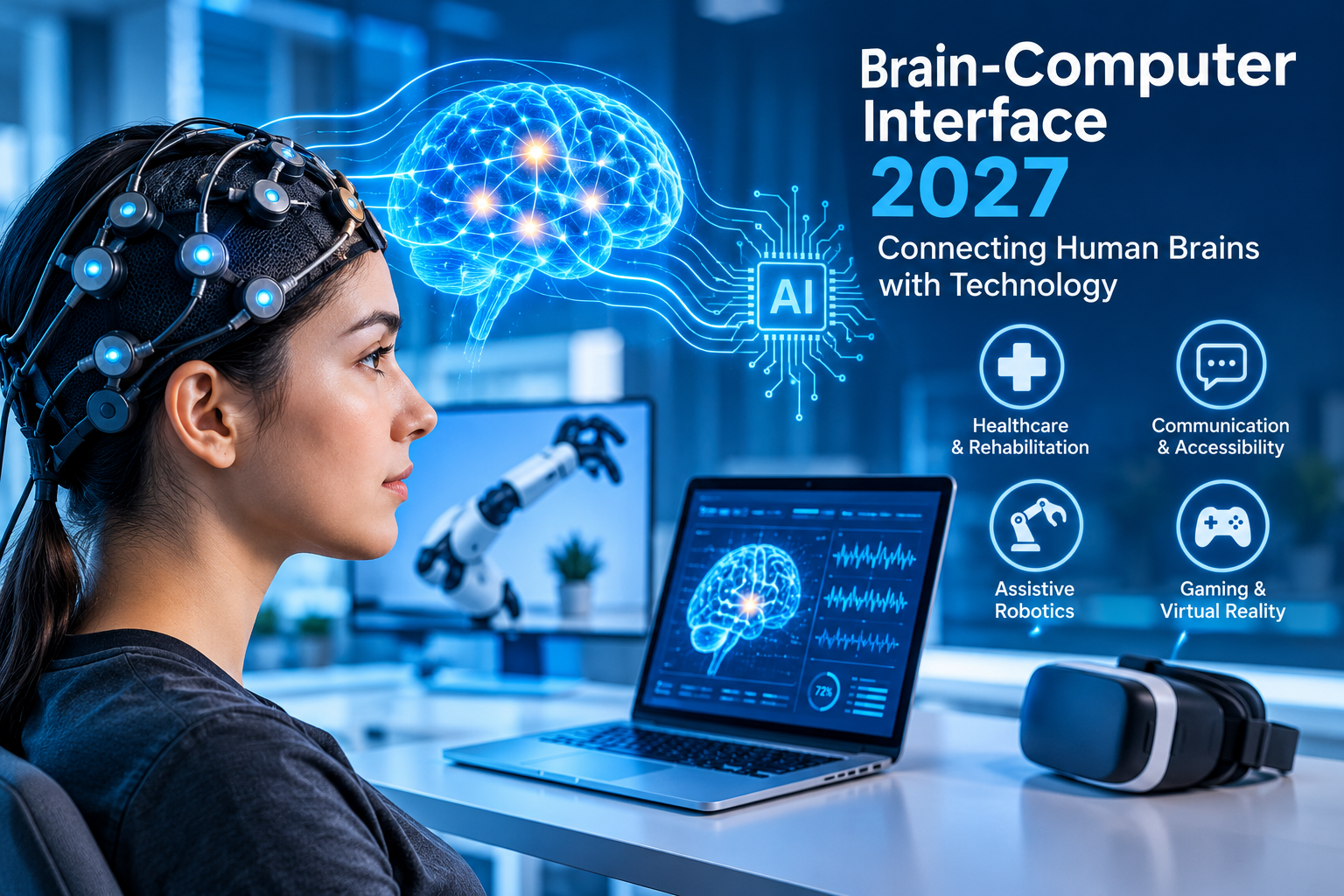
By 2027, researchers and technology companies are expected to continue improving BCI systems for medical assistance, communication, rehabilitation, and other specialized applications. However, the speed of progress will depend on clinical research, safety testing, regulatory approval, and the practical challenges of connecting the human brain with digital devices.
This article explores how brain-computer interface technology works, its potential applications, its advantages and disadvantages, and what the future may hold.
What Is Brain-Computer Interface Technology?
A brain-computer interface is a system that creates a direct communication pathway between the brain and an external device. Instead of relying entirely on traditional input methods such as a keyboard, mouse, or touchscreen, a BCI system measures brain activity and uses specialized software to interpret particular patterns.
These systems can use different technologies to measure brain signals. Some employ sensors placed on the scalp, while others use implanted electrodes that record neural activity more directly. Computer algorithms process the collected signals to identify patterns associated with a specific intended action.
For example, a person with severe movement limitations may use a specialized BCI system to select letters on a screen or control a computer cursor. These applications require extensive training and careful calibration, and their performance varies depending on the individual and the technology involved.
How Does a Brain-Computer Interface Work?
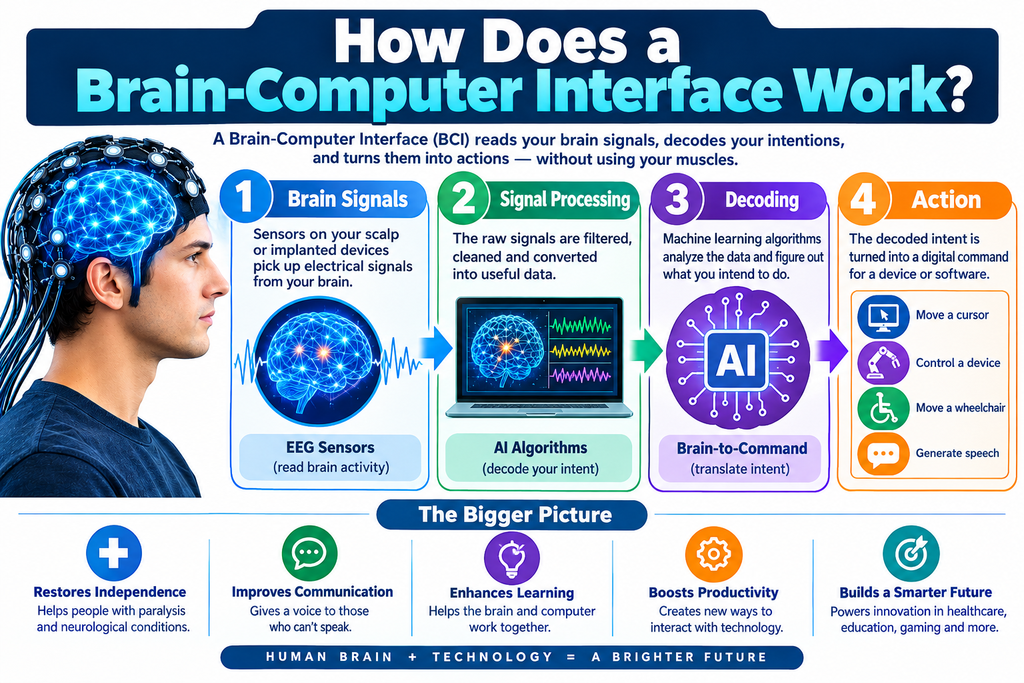
Brain-computer interface systems generally follow several important steps. First, sensors collect information about brain activity. Next, signal-processing software filters unwanted noise and identifies meaningful patterns. Machine-learning algorithms may then interpret these patterns and translate them into commands.
Finally, the connected device performs the requested action, such as moving a cursor, selecting a symbol, or controlling a compatible assistive device. Some systems also provide feedback, allowing users to adjust their brain activity and improve control over time.
Artificial intelligence can help these systems recognize complex signal patterns and adapt to individual users. Nevertheless, brain signals are complicated, and accurate interpretation remains a significant technical challenge.
The Future of Brain-Computer Interfaces in 2027
In 2027, BCI research may continue to advance in several important areas. Medical researchers are investigating ways to help people with paralysis communicate, interact with computers, and regain certain forms of independence.
Another area of development involves improving signal accuracy and reducing the time required to train users. Better algorithms, more efficient electronics, and improved electrode designs could help researchers develop systems that are easier to use and more reliable.
Non-invasive interfaces may also attract attention because they can measure brain activity without requiring surgery. However, they generally provide less direct access to neural signals than many implanted systems.
It is important to understand that 2027 is a point for evaluating ongoing progress, not a guaranteed date for widespread consumer adoption. Many advanced BCI applications will still require additional research and clinical validation.
Major Applications of Brain-Computer Interface Technology
1. Healthcare and Medical Rehabilitation
Healthcare is one of the most promising fields for brain-computer interface technology. Specialized systems may help people with neurological injuries or movement disorders interact with computers and assistive devices.
Researchers are also exploring how BCI systems can support rehabilitation by connecting brain activity with external feedback or movement-related technologies. The benefits depend on the patient’s condition and the specific system being studied.
2. Communication for People with Disabilities
Some people who cannot speak or move easily face significant communication barriers. Brain-computer interfaces may offer alternative ways to select letters, generate text, or interact with digital communication systems.
These technologies could provide valuable opportunities for people with severe motor disabilities. However, communication speed, accuracy, training requirements, and individual medical circumstances remain important considerations.
3. Artificial Intelligence Integration
Artificial intelligence can help interpret brain signals and identify patterns that may be difficult to detect using traditional signal-processing methods alone. AI models can also support personalization by adapting to changes in a user’s signals.
In the future, researchers may combine BCI technology with intelligent software to improve accessibility and device control. Such integration must be carefully designed to protect privacy and prevent unintended actions.
4. Gaming and Virtual Reality
Brain-computer interfaces may offer new ways to interact with games, virtual environments, and digital experiences. Experimental systems can investigate attention-related signals, mental-state measurements, or limited forms of hands-free interaction.
However, measuring brain activity is not the same as reading every thought. Consumer BCI gaming remains a developing field, and its practical capabilities vary considerably across products and research projects.
5. Assistive Robotics
BCI systems can potentially help users control compatible robotic arms, wheelchairs, or other assistive devices. This can be particularly valuable when conventional physical controls are difficult or impossible to operate.
Future improvements in signal interpretation and device feedback may make certain systems more practical. Safety remains essential because unintended commands could cause harm when controlling physical equipment.
Brain-Computer Interface Technology: Key Comparison
Brain-computer interfaces can be compared across several dimensions: non-invasive BCIs use external sensors and generally avoid surgery, making them easier to deploy but often limiting the detail of the signals they can capture; invasive BCIs use implanted electrodes to record neural activity more directly, potentially enabling more precise control but requiring surgery and long-term medical monitoring; medical BCIs focus on applications such as communication and rehabilitation, while experimental consumer BCIs explore gaming, accessibility, and hands-free interaction; traditional computer interfaces rely on physical input devices, whereas BCIs attempt to translate selected brain signals into commands, although their accuracy, usability, cost, and availability differ substantially.
Advantages of Brain-Computer Interface Technology
One major advantage of BCI technology is its potential to improve accessibility. People who cannot reliably use conventional input devices may gain alternative ways to communicate or control digital systems.
BCIs may also support medical research, rehabilitation, and new forms of human-computer interaction. When combined with suitable software, these systems could make certain tasks more accessible and reduce dependence on physical controls.
Another potential benefit is personalization. Some systems can be calibrated to recognize an individual’s signal patterns, potentially improving performance with practice.
Challenges and Risks of Brain-Computer Interfaces
Despite their potential, brain-computer interfaces face significant challenges. Accuracy is one concern because brain signals can be weak, noisy, and difficult to interpret consistently. Users may need extensive training, and performance can vary across individuals and environments.
Implanted systems introduce additional medical risks, including infection and complications associated with surgery. Non-invasive systems avoid these surgical risks but may offer more limited control.
Privacy is another major concern. Brain-related data may reveal sensitive information about a person’s neurological activity, so developers must establish strong safeguards for data collection, storage, access, and sharing.
Cost and accessibility also matter. Advanced medical systems can require specialized equipment, trained professionals, and ongoing support. Wider adoption will depend on safety, affordability, reliability, and appropriate regulatory oversight.
Brain Data Privacy and Ethical Considerations
As BCI technology develops, protecting users’ rights must remain a priority. Brain-related information should be handled with clear consent, appropriate security, and transparent policies explaining how data is used.
Researchers and companies should also consider who controls neural data, whether information can be shared with third parties, and how users can withdraw permission. Security vulnerabilities could create serious privacy concerns if sensitive data is exposed or misused.
Ethical development should focus on informed consent, equal access, user autonomy, and realistic communication about what a system can and cannot do. Brain-computer interfaces should not be marketed as devices that can freely read people’s private thoughts.
What to Expect from BCI Technology After 2027
Beyond 2027, continued advances in neuroscience, artificial intelligence, electronics, and materials science could improve the performance of brain-computer interfaces. Researchers may develop more comfortable sensors, better signal-processing methods, and more useful assistive applications.
Future systems could also combine BCI technology with robotics, augmented reality, and personalized digital assistants. Nevertheless, these possibilities depend on scientific evidence, successful testing, responsible regulation, and real-world usability.
The most meaningful progress may come from applications that solve specific problems, especially for people who need alternative communication or computer-control methods.
Conclusion
Brain-Computer Interface technology represents an important step toward new ways of connecting human neural activity with digital systems. By translating selected brain signals into commands, BCI systems may help improve accessibility, support medical rehabilitation, and expand human-computer interaction.
In 2027, the field is likely to remain an important area of research and specialized technological development. However, widespread adoption is not guaranteed, and major challenges involving accuracy, safety, cost, and privacy must be addressed.
As technology advances, responsible innovation will be essential. Brain-computer interfaces have significant potential, but their long-term value will depend on whether they become safe, reliable, practical, and genuinely useful to the people who need them.
Frequently Asked Questions (FAQs)
1. What is a Brain-Computer Interface (BCI)?
A Brain-Computer Interface (BCI) is a technology that allows the human brain to communicate directly with computers or external devices without requiring physical movement.
2. How does Brain-Computer Interface technology work?
BCI technology detects and analyzes brain signals using sensors and advanced software. Artificial intelligence processes these signals and converts them into commands that computers or devices can understand.
3. What are the main applications of Brain-Computer Interface technology?
BCI technology can be used in healthcare, medical rehabilitation, assistive communication, gaming, robotics, and hands-free device control.
4. Can Brain-Computer Interfaces help disabled people?
Yes. BCI systems may help people with paralysis or certain neurological conditions communicate, control assistive devices, and perform some tasks using brain signals.
5. Is Brain-Computer Interface technology safe?
Safety depends on the type of BCI system. Non-invasive systems generally avoid surgery, while implanted systems involve medical procedures and require careful monitoring.
6. What is the role of AI in Brain-Computer Interface technology?
Artificial intelligence helps analyze complex brain signals, recognize patterns, improve accuracy, and translate brain activity into useful commands.
7. Will Brain-Computer Interface technology become common in 2027?
BCI technology is expected to continue developing in 2027, particularly in medical research and assistive applications. However, widespread everyday adoption is not guaranteed.
8. What are the biggest challenges of Brain-Computer Interface technology?
Major challenges include high costs, signal accuracy, privacy concerns, data security, medical risks, and technical limitations.
9. Can Brain-Computer Interfaces control computers without a keyboard or mouse?
Yes. Some BCI systems can allow users to select objects, move cursors, or perform specific computer actions through interpreted brain signals.
10. What is the future of Brain-Computer Interface technology?
The future may include better medical treatments, advanced assistive devices, improved human-computer communication, and new ways to interact with digital technology.
Brain-Computer Interface 2027, BCI technology, brain-computer interface technology, future technology 2027, neural interface technology, AI brain technology, brain signal processing, human-computer interaction, medical BCI applications, non-invasive brain-computer interface, invasive neural interfaces, assistive technology, brain data privacy, future of neuroscience, AI-powered healthcare.
#BrainComputerInterface #BCITechnology #FutureTechnology #Technology2027 #ArtificialIntelligence #NeuralTechnology #BrainTech #EmergingTechnology #HealthcareInnovation #TechLogic