
What if a sports car could drive at incredible speeds, climb an upside-down track, and briefly launch itself into the air? This idea sounds like something from a science-fiction movie, but Tesla has brought it into the spotlight with its redesigned Roadster and experimental rocket-inspired technology. In October 2026, Tesla unveiled the long-awaited vehicle at a demonstration in Texas, attracting attention from automotive enthusiasts and technology lovers around the world.
The new Tesla Roadster combines electric-car engineering with technology developed in collaboration with SpaceX. The company demonstrated a vehicle using specialized thrusters to perform a short airborne manoeuvre, raising an important question: could flying cars become a real part of our future? Although the demonstration was impressive, several questions remain about safety, pricing, production, and practical flight capabilities.
Here are seven shocking facts about Tesla’s new flying-car concept that explain what makes this vehicle different from ordinary electric cars.
1. Tesla’s New Roadster Can Briefly Lift Off the Ground
The most surprising feature of Tesla’s new Roadster is its ability to perform brief airborne manoeuvres. During its October 2026 unveiling, the demonstration vehicle used specialized thrusters to leave the ground, rotate in the air, and return to the surface.
Unlike conventional cars, which rely on their tyres to remain connected to the road, an airborne vehicle must generate force to support its weight and control its movement. Tesla’s proposed Rocket configuration uses cold-gas thrusters positioned around the vehicle to produce controlled bursts of thrust.
However, there is an important difference between briefly jumping into the air and flying like an aircraft. The demonstration did not establish sustained flight over long distances or prove that customers could safely use the vehicle in everyday conditions. The Roadster is an exciting engineering experiment, but its practical flying capabilities still require further validation.
2. The Car Uses SpaceX-Inspired Rocket Thrusters
Another remarkable feature is the collaboration between Tesla and SpaceX, the aerospace company also led by Elon Musk. The Roadster’s proposed advanced configurations use cold-gas thrusters, a technology related to propulsion systems used in aerospace engineering. These systems release pressurized gas through nozzles to generate force, allowing an object to change its movement or orientation.
This approach differs from conventional flying cars that use propellers, wings, or ducted fans to produce lift.
3. Tesla’s Suction System Can Hold the Car Upside Down
One of the strangest features demonstrated during the unveiling was the Roadster’s ability to travel along a curved track and remain attached while upside down. This manoeuvre relies on a specialized fan and ground-sealing system designed to pull air from beneath the vehicle, generating strong suction and downforce.
Ordinary sports cars depend on aerodynamic downforce, which pushes a vehicle toward the road as air moves around its body. Tesla’s proposed suction system takes a different approach by actively removing air from beneath the car. The resulting pressure difference can help hold the vehicle against a suitable surface, even when gravity would normally pull it away.
This system could improve grip during specialized track manoeuvres and help demonstrate the Roadster’s advanced engineering. However, suction-based downforce does not independently make the vehicle fly.
4. The Roadster Has Three Different Configurations
Tesla’s redesigned Roadster is not a single vehicle configuration with identical features across every model. The company describes three versions: Performance, Thrust, and Rocket.
These differences matter because headlines about a flying Tesla can create the impression that every Roadster will have the same airborne capabilities. That is not the case. Buyers must check the specifications of the exact configuration rather than assuming that the regular road-oriented model can perform every manoeuvre demonstrated by the experimental version.
5. Tesla Claims Extremely Fast Acceleration and High Performance
Speed is another major part of the Roadster’s appeal. Tesla has presented the redesigned vehicle as an exceptionally powerful electric sports car, with the Thrust configuration claimed to accelerate from zero to 60 miles per hour in under one second.
The vehicle also combines electric propulsion with aerodynamic engineering and specialized systems designed to increase grip. The proposed thrusters provide an additional engineering element that separates the advanced versions from conventional electric sports cars.
Real-world acceleration depends on the vehicle configuration, testing surface, conditions, and measurement method. Prospective buyers should wait for final production specifications and reliable test results before making decisions based on headline performance claims.
6. Tesla’s Flying Roadster Has Impressive Specifications, but Some Details Remain Unconfirmed
The redesigned Roadster is planned as a high-performance electric sports car with advanced aerospace-inspired features. Tesla’s current product information describes the Performance, Thrust, and Rocket configurations, while the more advanced versions include cold-gas thrusters. The company has also presented a range exceeding 300 miles in its current Roadster information. However, the final battery capacity, motor output, vehicle weight, and other detailed production figures should be checked against the specifications for the exact configuration.
The Rocket version is particularly unusual because it is designed to support upward and sideways movement as well as rotational manoeuvres. It is described as a single-seat model and is not approved for public-road use. The table below summarizes the principal details while distinguishing announced features from specifications that have not been fully confirmed.
| Specification | Details |
|---|---|
| Manufacturer | Tesla |
| Vehicle type | All-electric sports car |
| Configurations | Performance, Thrust, Rocket |
| Seating | Two seats in Performance and Thrust; one in Rocket |
| Propulsion | Electric powertrain |
| Advanced technology | Cold-gas thrusters on Thrust and Rocket versions |
| Range | Tesla lists more than 300 miles |
| Acceleration | Thrust version claimed to reach 60 mph in under one second |
| Rocket version | Invitation-only, with a proposed flight system |
| Final battery capacity | Not confirmed in the listed specifications |
| Final production price | Not announced |
| Production target | 2028, subject to change |
| Public-road approval | Rocket version not approved for public-road use |
These details make the Roadster one of Tesla’s most unusual projects, but they should not be interpreted as proof that every version can fly. The airborne features belong to the proposed advanced configuration, and final specifications may change before production.
7. The Tesla Flying Car Could Change Future Transportation
Flying-car technology has the potential to influence how engineers think about personal transportation. If vehicles combining road travel and flight eventually become safe and practical, they could support specialized travel, emergency applications, or access to locations that are difficult to reach by conventional vehicles. Developments in propulsion, automated controls, lightweight materials, and navigation could also benefit other areas of transportation engineering.
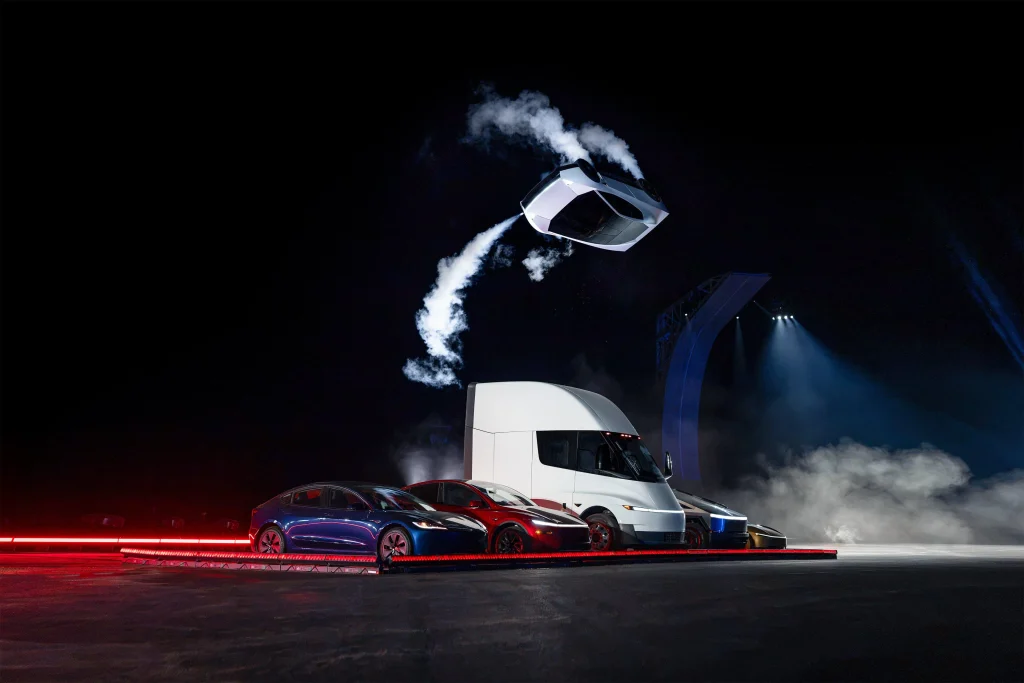
However, several major challenges remain. Flying vehicles need reliable propulsion, safe operating areas, effective traffic management, and clear rules governing their use. They must also address weather conditions, energy consumption, noise, maintenance, and the risk of accidents. A vehicle that performs a brief airborne stunt has not necessarily demonstrated the ability to provide safe, everyday transportation.
Its development could encourage new ideas, but widespread adoption will depend on successful testing, practical costs, regulatory approval, and reliable performance outside controlled demonstrations.
When Will Tesla’s New Roadster Be Available?
Tesla has targeted 2028 for the start of production, according to reporting following the October 2026 unveiling.
Tesla has not announced a final price for the redesigned model at the unveiling. Anyone considering a reservation should review the current official terms and understand that a reservation does not guarantee a delivery date or approval to operate the vehicle on public roads.
Final Verdict
Tesla’s new Roadster combines electric sports-car engineering with an experimental approach to rocket-inspired propulsion. Its brief airborne demonstration, specialized thrusters, suction-based downforce system, and multiple configurations make it a fascinating technology story in 2026.
Nevertheless, its long-term success will depend on more than an impressive demonstration. Final production specifications, safety testing, regulatory approval, pricing, and reliable real-world performance will determine whether its most ambitious features become practical. For now, the Tesla Roadster represents a bold step toward exploring the boundaries between electric cars and aerospace technology.
Frequently Asked Questions(FAQs)
1. Can Tesla’s new Roadster really fly?
Tesla demonstrated brief airborne manoeuvres using specialized thrusters. However, sustained flight and routine real-world operation have not been established by the demonstration.
2. What are the three Tesla Roadster versions?
Tesla describes Performance, Thrust, and Rocket configurations. Their seating, intended use, and propulsion features differ.
3. How fast is the new Tesla Roadster?
Tesla claims the Thrust version can accelerate from zero to 60 mph in under one second. Independent verification and final production specifications are still important.
4. How much does the Tesla flying car cost?
Tesla did not announce a final price for the redesigned Roadster at the unveiling. Pricing may differ between configurations.
5. When will the Tesla Roadster launch?
Production is targeted for 2028, but this date may change.
6. Is the flying version legal on public roads?
Tesla states that the Rocket configuration is not approved for public-road use.
7. Is Tesla’s flying car available to everyone?
The Rocket configuration is described as invitation-only. Availability and operating restrictions may differ from the regular Roadster.
Tesla flying car price, Tesla Roadster specifications, Tesla Roadster release date, Elon Musk flying car, flying cars in 2026, SpaceX thruster technology.
#TeslaFlyingCar #TeslaRoadster #ElonMusk #FlyingCars #FutureTechnology #SpaceX #ElectricCars