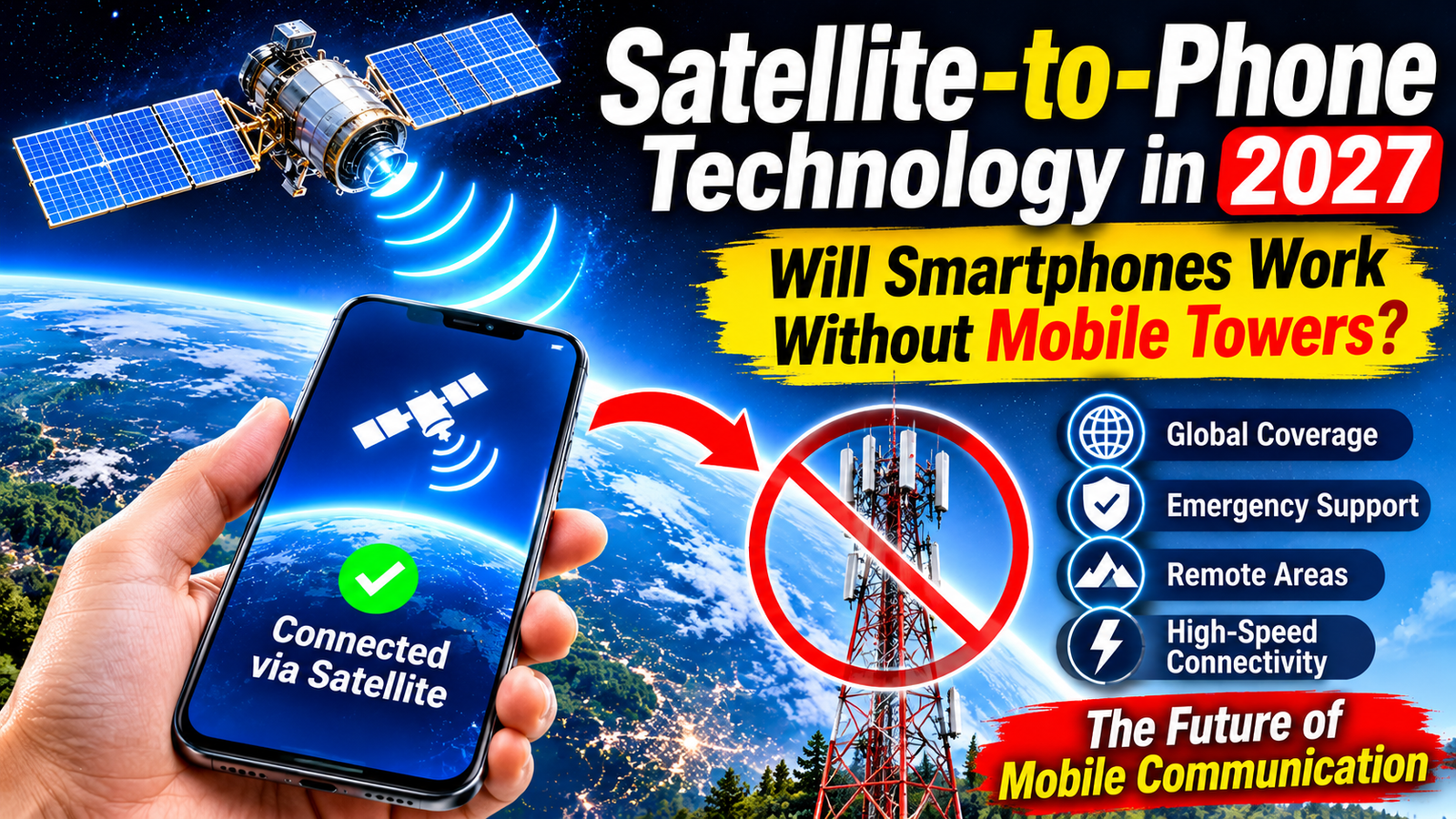
Imagine traveling through a remote mountain area, driving across an empty highway, or visiting a location where mobile signals are unavailable. Normally, your smartphone would display a weak signal or no service at all. But a new generation of communication technology is changing that experience.
Satellite-to-phone technology, also known as Direct-to-Device (D2D) connectivity, allows compatible smartphones and other devices to communicate directly with satellites in orbit.
Instead of depending entirely on traditional cell towers, this technology uses satellites to extend wireless connectivity into areas that existing mobile networks cannot easily reach.
But how does this technology work, and will it really allow smartphones to operate without mobile towers?
What Is Satellite-to-Phone Technology?
Traditional mobile networks use cell towers to transmit and receive signals from smartphones. When a user moves outside the coverage area, the connection may become unavailable.
Direct-to-Device technology aims to reduce this limitation by using satellites as an additional part of the communication network.
These satellites operate in space and communicate with compatible devices using allocated radio frequencies and specialized network technology.
Depending on the service, users may be able to send text messages, access emergency communication features, or eventually use more advanced mobile services.
An important distinction is that satellite connectivity does not mean every smartphone can automatically access the internet from anywhere. Device compatibility, satellite coverage, regulatory approval, and service availability still matter.
How Does Direct-to-Device Satellite Connectivity Work?
Direct-to-Device technology connects smartphones or other compatible devices directly to satellites in orbit.
The process involves several important steps.
1. Your Smartphone Searches for a Satellite Signal
When a compatible phone enters an area without normal cellular coverage, it may search for an available satellite connection.
The device needs suitable hardware, software, and network support to establish communication.
2. The Satellite Receives the Signal
A satellite in low Earth orbit can receive radio signals transmitted by a compatible device.
Low Earth orbit satellites operate much closer to Earth than traditional geostationary communications satellites, which can help reduce communication delays.
3. The Network Processes the Communication
Depending on the system, the satellite may communicate with ground infrastructure or other network components to route the information.
The mobile operator and satellite provider work together to manage connectivity.
4. Information Reaches Its Destination
The message or other supported data is delivered through the network to the intended recipient.
This process can make communication possible in places where conventional cellular infrastructure is unavailable.
Why Is Satellite-to-Phone Technology Important in 2027?
Traditional mobile networks cannot economically cover every location.
Building cell towers in remote mountains, deserts, forests, oceans, and isolated rural communities can be expensive and technically difficult.
Satellite-to-phone technology offers another way to extend communication services.
1. Connectivity in Remote Areas
People living or working in remote locations often experience limited cellular coverage.
Direct-to-Device services could help improve communication for travelers, outdoor workers, agricultural businesses, and people living far from major cities.
2. Emergency Communication
Natural disasters can damage mobile towers, electricity infrastructure, and communication networks.
Satellite connectivity can provide an additional communication option when conventional networks are disrupted.
Emergency messaging may become especially valuable for people who need assistance in isolated locations.
3. Better Connectivity for Travelers
Road trips, hiking, camping, and outdoor adventures frequently take people beyond normal mobile coverage.
Satellite-enabled smartphones could make it easier to maintain basic communication during these activities.
However, users should check coverage and service requirements before relying on satellite communication for safety.
4. Support for Connected Devices
The technology is not limited to smartphones.
Satellite networks can also support connected vehicles, tracking devices, agricultural equipment, industrial sensors, and other Internet of Things applications.
This could help businesses monitor equipment and assets in locations where terrestrial connectivity is limited.
Latest Satellite-to-Phone Developments in November 2026
The satellite communication industry has recently reached several important milestones.AT&T and AST SpaceMobile demonstrated a successful handoff between cellular and satellite networks in October 2026. Rakuten and AST SpaceMobile also announced a Japanese satellite connectivity joint venture in November 2026. about.att.com+2
These developments show that direct-to-device connectivity is moving toward broader commercial applications.
Iridium Activates Its NTN Direct Service
On November 17, 2026, Iridium announced the activation of Iridium NTN Direct.
The company describes it as a standards-based satellite service supporting narrowband Internet of Things and direct-to-device connectivity.
The service uses Iridium’s low Earth orbit satellite constellation and is designed to support compatible devices and applications worldwide.
Potential applications include emergency messaging, asset tracking, connected vehicles, industrial monitoring, and smart agriculture.
However, actual availability depends on compatible equipment, service providers, and regulatory authorization in each market.
European Space Agency and SES Advance Direct-to-Device Connectivity
On November 17, 2026, the European Space Agency and SES announced the SELYCE Direct-to-Device partnership project.
The initiative aims to develop technologies that can connect everyday devices, including smartphones, vehicles, and sensors, directly to satellites.
Its initial focus includes messaging, emergency voice communication, vehicle connectivity, and communication during disasters.
The project is an important development in Europe’s efforts to expand satellite-enabled communication infrastructure.
AT&T and AST SpaceMobile Achieve a Network Handoff Milestone
On November 2, 2026, AT&T and AST SpaceMobile announced a successful handoff between a ground-based cellular network and a direct-to-device satellite network.
This development is important because it demonstrates progress toward maintaining connectivity as a device moves between traditional cellular coverage and satellite coverage.
The goal is to make the transition more seamless for users rather than requiring them to manually switch between different communication systems.
Rakuten and AST SpaceMobile Plan a Japanese Satellite Network
On November 9, 2026, Rakuten and AST SpaceMobile announced a joint venture called Rakuten AST.
The initiative aims to develop a satellite-to-device communications network in Japan.
The project is designed to extend connectivity to compatible smartphones and strengthen communication infrastructure during natural disasters and other emergencies.
These developments show that satellite connectivity is becoming a major area of investment for telecommunications companies.
Satellite Internet vs. Direct-to-Phone Technology
Satellite internet and direct-to-phone connectivity are related, but they are not exactly the same.
Traditional satellite internet services commonly use specialized equipment, such as satellite dishes or dedicated terminals.
Direct-to-Device technology aims to connect compatible everyday devices directly to satellites.
| Feature | Traditional Satellite Internet | Direct-to-Phone Technology |
|---|---|---|
| Main equipment | Satellite terminal or dish | Compatible smartphone or device |
| Connection | Satellite terminal to satellite | Device directly to satellite |
| Installation | Often requires dedicated equipment | May not require a separate dish |
| Main applications | Broadband internet | Messaging and other supported services |
| Mobility | Depends on equipment and service | Designed for mobile devices |
| Coverage | Depends on satellite provider | Depends on satellite network and service |
Direct-to-Phone services are still developing, and their capabilities vary significantly between providers.
Can Smartphones Really Work Without Mobile Towers?
Yes, compatible smartphones can communicate with satellites without using a nearby conventional mobile tower for that satellite connection.
However, this does not mean traditional mobile networks will disappear.
Satellite networks are generally expected to complement terrestrial cellular infrastructure rather than replace it completely.
Mobile towers will remain important because they can provide high-capacity connections in cities, towns, and densely populated areas.
Satellite connectivity is particularly useful where installing or maintaining cellular infrastructure is difficult.
The future of mobile communication is likely to involve both systems working together.
Benefits of Satellite-to-Phone Technology
Direct-to-Device connectivity offers several potential advantages.
Expanded Coverage: Satellites can extend communication services into remote locations beyond conventional cellular coverage.
Emergency Support: Satellite communication may provide an alternative connection during certain network outages and natural disasters.
Improved Mobility: Compatible devices may maintain communication in areas where traditional mobile coverage is unavailable.
Connected Infrastructure: Businesses can use satellite connectivity for vehicles, sensors, tracking systems, and remote equipment.
Network Resilience: Combining terrestrial and satellite networks can create additional communication options when one network becomes unavailable.
Challenges and Limitations of Satellite-to-Phone Connectivity
Although satellite-to-phone technology has significant potential, several challenges remain.
Device Compatibility
Not every smartphone supports direct satellite connectivity.
Users may need a compatible device, modem, antenna design, software update, or supported mobile service.
Signal Conditions
Satellite communication can be affected by buildings, trees, mountains, and other physical obstructions.
An open view of the sky may be required for some services.
Network Capacity
Satellites have limited communication resources.
Supporting millions of users simultaneously requires careful management of available spectrum and network capacity.
Regulatory Requirements
Satellite services must comply with telecommunications regulations and spectrum authorization requirements in different countries.
A service available in one country may not be available in another.
Service Costs
Pricing depends on the satellite provider, mobile operator, service type, and subscription arrangements.
Users should check whether satellite messaging or other features are included in their existing plans or require additional payment.
What Does Satellite-to-Phone Technology Mean for the United States?
The United States is an important market for direct-to-device connectivity because of its large geographical area, remote communities, national parks, highways, and extensive mobile communications industry.
Satellite connectivity could provide additional communication options for people traveling through areas with limited cellular coverage.
It may also support emergency responders, transportation businesses, agricultural operations, and industrial activities.
Partnerships between satellite operators and established mobile carriers could make the technology easier to access through compatible smartphones.
However, coverage, pricing, supported devices, and regulatory permissions will determine how quickly these services become available to consumers.
The Future of Satellite-to-Phone Technology Beyond 2027
The future of direct-to-device communication will depend on improvements in satellite hardware, mobile chipsets, network integration, and telecommunications standards.
Future systems may support more advanced services, including voice calls, broader data connectivity, and improved integration with traditional cellular networks.
Low Earth orbit satellite constellations are also expected to play an important role in expanding global communication infrastructure.
The development of 5G and future 6G non-terrestrial networks could further improve how satellites and terrestrial mobile networks work together.
However, widespread adoption will require affordable services, compatible devices, sufficient network capacity, and international regulatory cooperation.
Satellite-to-phone technology is not simply about connecting smartphones to space. It represents a broader change in how communication networks can be designed and expanded.
Final Thoughts
Satellite-to-phone technology is becoming one of the most interesting developments in modern telecommunications.
By allowing compatible devices to communicate directly with satellites, Direct-to-Device connectivity can help extend communication beyond the limits of traditional mobile towers.
Recent developments from Iridium, the European Space Agency, SES, AT&T, AST SpaceMobile, and Rakuten demonstrate growing industry interest in this technology.
Although satellite connectivity will not replace conventional mobile networks in 2027, it could become an important additional layer of global communication.
As the technology develops, staying connected in remote areas may become easier, safer, and more reliable than ever before.
Satellite phone technology, Direct-to-Device connectivity, satellite smartphone connection, satellite internet 2027, smartphones without mobile towers, Starlink Direct to Cell, satellite mobile networks, future wireless technology
Satellite Technology, Smartphone Technology, Direct-to-Device, Starlink, Wireless Connectivity, Future Technology, Mobile Networks