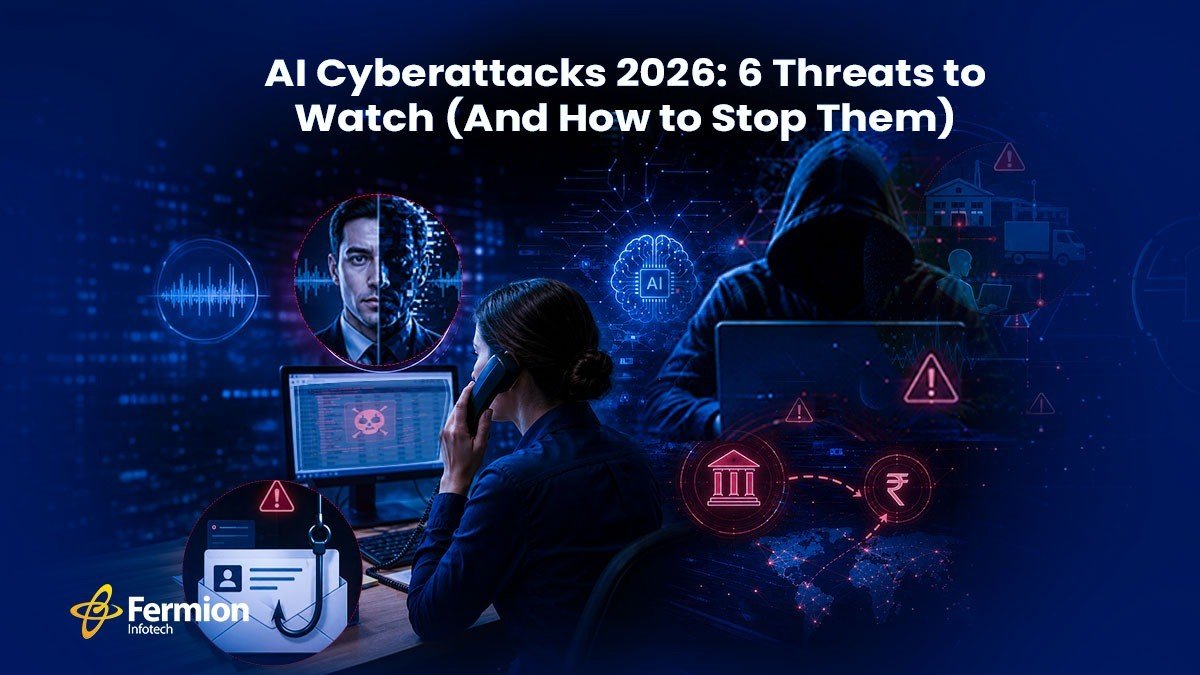
Artificial intelligence is transforming cybersecurity—but it is also giving cybercriminals more powerful tools to attack individuals, businesses, and governments. In 2026, attackers can use AI to automate scams, create convincing fake content, discover vulnerabilities, and adapt their techniques faster than ever.
The result is a rapidly changing cybersecurity landscape where traditional defenses are no longer enough. Organizations need to understand how AI is changing cybersex threats and what they can do to reduce their risk.
How AI Is Changing Cybercrime
Cybercriminals have always looked for ways to automate their operations. AI makes that process significantly easier.
Instead of manually writing phishing emails, researching targets, or analyzing stolen information, attackers can increasingly use AI-powered systems to perform these tasks at scale. AI can also help criminals personalize attacks based on information collected from social media, company websites, and previous data breaches.
This means even relatively inexperienced attackers may be able to launch sophisticated campaigns.
1. AI-Powered Phishing and Social Engineering
Phishing remains one of the most common cybersecurity threats, but AI is making phishing messages more convincing.
Generative AI can produce emails and messages with better grammar, realistic language, and personalized details. Attackers can create different versions of a scam for specific employees, departments, or organizations.
AI can also assist with:
- Personalized phishing emails
- Fake customer-support conversations
- Automated scam messages
- Impersonation of executives or employees
- Multilingual social-engineering campaigns
Because AI-generated messages may contain fewer obvious spelling and grammar mistakes, employees can no longer rely on poor writing quality as a warning sign.
2. Deepfakes and AI Impersonation
Deepfake technology presents another growing risk.
Attackers can use AI-generated audio, images, and video to imitate real people. A criminal might attempt to impersonate a company executive and persuade an employee to transfer money or reveal sensitive information.
Voice cloning is particularly concerning because a short sample of someone’s voice may be enough to create convincing synthetic audio.
For businesses, this means identity verification needs to go beyond simply recognizing a person’s voice, face, or writing style.
3. Automated Vulnerability Discovery
AI can help attackers analyze software, networks, and applications much faster.
Instead of manually examining a large environment for weaknesses, AI-assisted tools can help identify potentially vulnerable systems and prioritize targets. Attackers may use these capabilities to discover security gaps before organizations have time to patch them.
The same technology can, of course, be used defensively. Security teams can use AI to identify vulnerabilities, analyze code, and prioritize remediation.
This creates an ongoing race between attackers and defenders.
4. AI-Assisted Malware
Malware developers can potentially use AI to improve different stages of an attack.
AI may assist criminals with generating or modifying malicious code, researching technical documentation, and adapting campaigns. Automated systems can also help attackers analyze environments after gaining unauthorized access.
The important point is not that AI has magically created unstoppable malware. Rather, AI can reduce the time and expertise required to develop and modify malicious tools.
5. Faster and More Personalized Attacks
Traditional cyberattack often depend on repetitive manual work. AI allows attackers to automate parts of this process.
An AI-assisted campaign could potentially analyze information about thousands of targets and customize messages for each one. This makes large-scale attacks more personalized and potentially harder to identify using simple rules.
Organizations therefore need defenses that can detect unusual behavior rather than relying only on static signatures.
6. Data Poisoning and Attacks Against AI Systems
As businesses increasingly depend on AI, the AI systems themselves become potential targets.
Data poisoning occurs when attackers manipulate training or input data in ways that can influence an AI system’s behavior. Attackers may also attempt to exploit weaknesses in AI applications, manipulate prompts, or extract sensitive information.
Organizations using AI should therefore treat AI security as part of their broader cybersecurity strategy.
7. Automated Reconnaissance
Before launching an attack, criminals often gather information about their targets.
AI can help automate reconnaissance by processing large quantities of publicly available information. Attackers may use it to identify employees, technologies, organizational relationships, exposed systems, and potential weaknesses.
This makes an organization’s digital footprint increasingly important.
Businesses should regularly review what information about their infrastructure and employees is publicly accessible.
8. Ransomware Becomes More Efficient
Ransomware remains a serious threat to organizations, and AI could make certain parts of ransomware operations more efficient.
AI-assisted systems could potentially help attackers identify valuable targets, automate reconnaissance, or improve social-engineering campaigns used to gain initial access.
However, the biggest risk is not necessarily a completely new form of ransomware. It is the possibility that existing criminal operations become faster, cheaper, and more salable.
Why Traditional Cybersecurity Is No Longer Enough
Firewalls, antivirus software, passwords, and security policies remain important, but modern organizations need a broader approach.
Cybersecurity teams increasingly need to focus on:
- Identity and access management
- Multi-factor authentication
- Continuous monitoring
- Employee security awareness
- Endpoint protection
- Cloud security
- Data protection
- AI application security
- Regular vulnerability management
- Incident-response planning
The goal should be to build multiple layers of defense so that one compromised account or device does not automatically result in a major breach.
How Organizations Can Defend Against AI-Powered Threats
There is no single solution that eliminates AI-related cybersex risks. Instead, organizations should combine technology, policies, and employee awareness.
Strengthen Identity Security
Use multi-factor authentication wherever possible, particularly for administrator accounts, email, cloud services, and financial systems.
Organizations should also apply least-privilege principles so that users have only the access they actually need.
Train Employees to Recognize AI-Generated Scams
Security awareness training should evolve alongside attack techniques.
Employees should be taught to question unusual requests involving payments, passwords, sensitive information, or urgent actions—even when the request appears to come from someone they know.
For high-risk transactions, organizations should use independent verification procedures.
Monitor for Unusual Behavior
AI-powered defensive tools can help security teams analyze large amounts of activity and identify anomalies.
Instead of asking only whether a file is known to be malicious, organizations can also ask whether the behavior of a user, device, or application is unusual.
Protect AI Systems
Companies deploying AI applications should secure the entire AI life cycle, including data, models, Apish, prompts, access controls, and outputs.
Sensitive information should not be unnecessarily exposed to AI systems, and organizations should establish clear policies governing how employees use AI tools.
Keep Systems Updated
Software vulnerabilities remain a major source of cybersex risk.
Regular patching, vulnerability scanning, secure configurations, and asset inventories can reduce opportunities for attackers to exploit outdated systems.
The Human Factor Still Matters
Despite rapid advances in AI, people remain one of the most important parts of cybersecurity.
Technology can detect suspicious activity, but employees still make decisions about whether to click a link, approve a transaction, share information, or grant access.
A strong security culture therefore matters just as much as advanced security technology.
Employees should feel comfortable reporting suspicious messages or mistakes without fear of punishment. Early reporting can give security teams valuable time to contain an attack.
The Future of AI and Cybersecurity
AI is not simply a threat to cybersecurity. It is also one of the industry’s most promising defensive technologies.
Security teams can use AI to analyze logs, detect anomalies, summarize alerts, investigate incidents, identify vulnerabilities, and accelerate response times.
This creates an important reality: the future of cybersecurity will involve AI on both sides of the fight.
Attackers will continue looking for ways to automate and improve their operations, while defenders will use AI to detect and respond to threats more quickly.
Organizations that understand both sides of this equation will be better prepared.
Conclusion
AI-powered cybersex threats are becoming an important part of the cybersecurity landscape in 2026. From highly personalized phishing and deepfake impersonation to automated reconnaissance, AI attacks, and more efficient cybercrime operations, the technology is changing how threats are created and deployed.
But AI does not make cybersecurity hopeless.
Organizations can reduce their exposure by strengthening identity security, training employees, monitoring systems continuously, protecting AI applications, maintaining software updates, and preparing effective incident-response plans.
The biggest mistake is assuming that cybersecurity is only a technology problem. In the age of AI, security requires technology, people, processes, and constant adaptation.
The organizations that prepare today will be in a much stronger position to handle the AI-powered threats of tomorrow.