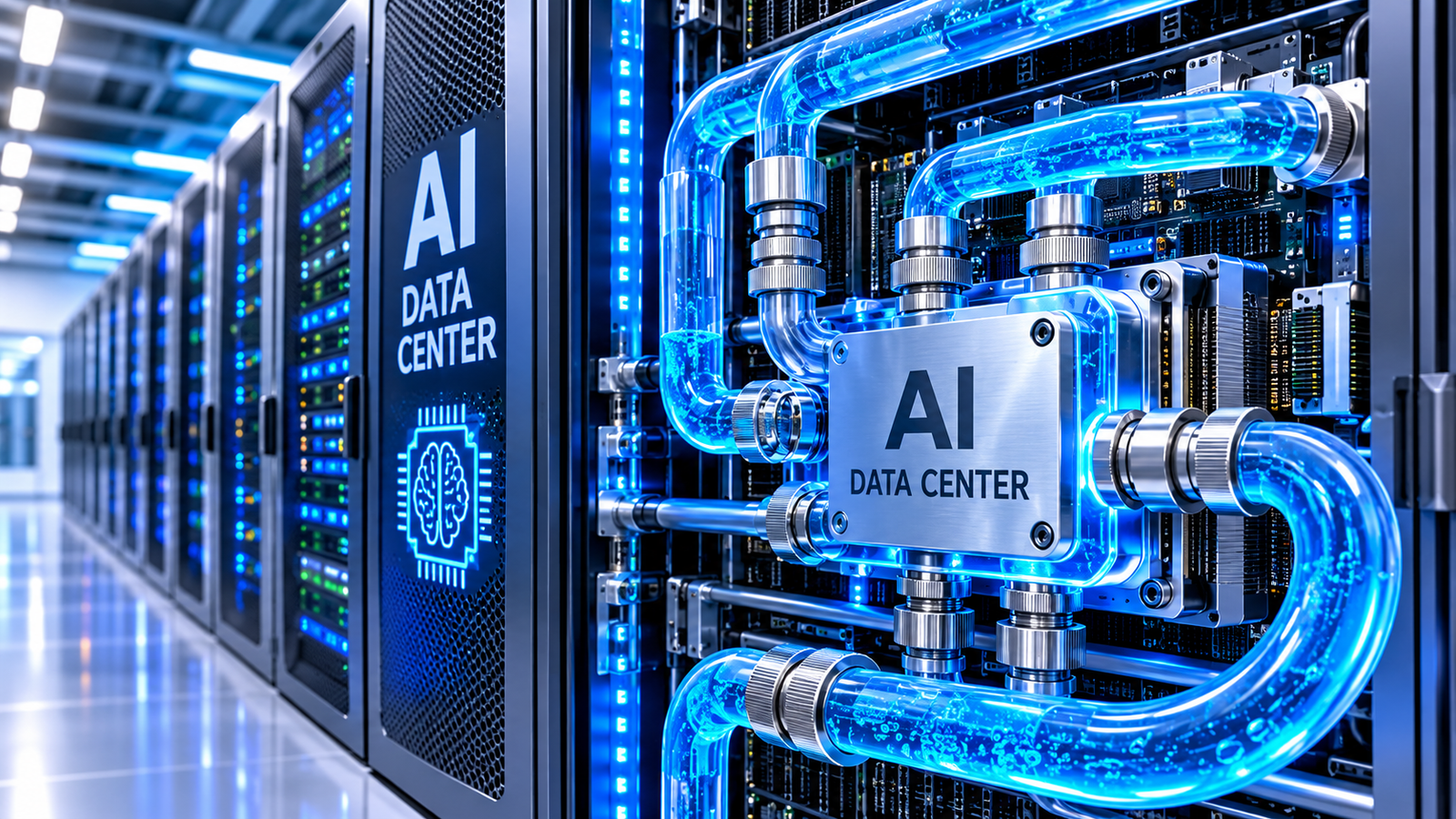
Artificial intelligence is changing the technology industry, but behind every powerful AI model is a massive computing infrastructure. However, these powerful processors produce enormous amounts of heat.
As a result, technology companies are exploring advanced liquid cooling solutions to keep servers operating safely and efficiently.
What Is AI Data Center Liquid Cooling?
Unlike traditional air cooling, which depends on fans and airflow, liquid cooling transfers heat through a circulating liquid.
This approach is particularly useful for AI servers because advanced GPUs and processors generate significant amounts of heat during intensive computing operations.
Liquid cooling can help data centers maintain stable temperatures, support higher computing density, and improve overall thermal management.
Why AI Data Centers Need Advanced Cooling Technology
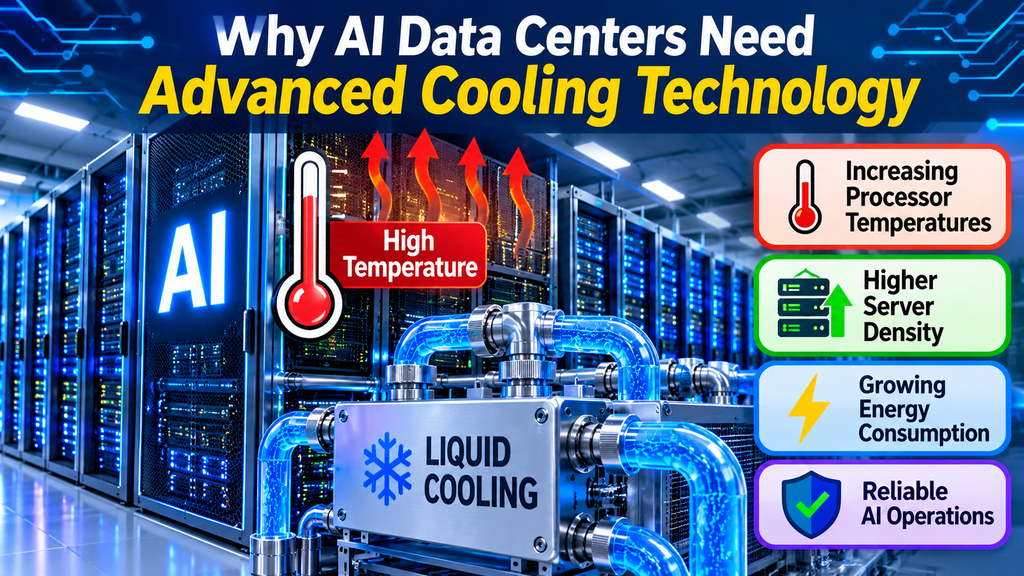
If temperatures become too high, hardware performance may decrease, or systems may become unstable.
1. Higher Server Density
2. Growing Electricity Consumption
Cooling systems require electricity to operate. More efficient thermal management can help data centers reduce unnecessary energy consumption.
3. Reliable AI Operations
AI services need dependable computing infrastructure. Effective cooling helps protect hardware and supports stable operations.
How Liquid Cooling Technology Works
Liquid cooling systems use different approaches to transfer heat away from computer hardware.
1. Direct-to-Chip Liquid Cooling
Direct-to-chip cooling uses specially designed cold plates attached to processors such as GPUs and CPUs.
A coolant flows through small channels inside these plates, absorbing heat directly from the components.
The heated liquid then travels to a heat exchanger, where the temperature is reduced before the liquid circulates again.
This approach is attracting attention because it can remove heat directly from some of the hottest components in an AI server.
2. Immersion Cooling
Immersion cooling takes a different approach. Instead of attaching cooling plates to individual components, servers are placed inside tanks filled with specially engineered dielectric liquid.
This liquid is designed to avoid conducting electricity, allowing compatible electronic equipment to operate while surrounded by coolant.
Immersion cooling can provide uniform heat removal and is being explored for demanding computing environments.
3. Two-Phase Liquid Cooling
Two-phase cooling uses the process of evaporation and condensation to transfer heat.
When the liquid absorbs enough heat, it changes into vapor. The vapor then moves toward a cooling surface, where it releases heat and turns back into liquid.
This process can provide effective thermal management for high-performance computing systems.
Latest Developments in AI Data Center Cooling
The data center industry is moving toward more advanced cooling infrastructure as AI computing requirements increase.
In November 2026, developments highlighted at SuperComputing 2026 included a two-phase direct liquid cooling system designed for AI and high-performance computing racks, with a reported cooling capacity of up to 200 kW per rack.
This demonstrates how cooling manufacturers are preparing for increasingly powerful server systems.
Companies are also exploring intelligent cooling controls that coordinate computing workloads with cooling infrastructure. These systems can help adjust cooling operations according to server demand.
The wider industry trend is clear: data center performance increasingly depends on power delivery, cooling, networking, and processors working together.
Benefits of Liquid Cooling for AI Infrastructure
Liquid cooling offers several potential advantages for modern data centers.
Better Heat Management: Liquid can transfer heat efficiently from high-temperature components, helping maintain stable operating conditions.
Higher Computing Density: Advanced cooling solutions can support server configurations that would be difficult to manage with traditional air cooling alone.
Potential Energy Savings: Efficient cooling designs may reduce the electricity required for thermal management, depending on system architecture and operating conditions.
Improved Hardware Reliability: Maintaining appropriate temperatures can help reduce thermal stress and support reliable server operation.
Support for Future AI Systems: As AI processors become more powerful, advanced cooling technologies will play a greater role in infrastructure planning.
Challenges of Liquid Cooling Technology
Despite its advantages, liquid cooling also comes with challenges.
High Installation Costs: Specialized cooling equipment, plumbing, heat exchangers, and monitoring systems can increase initial investment.
Maintenance Requirements: Data center operators need trained technicians to inspect coolant systems, connections, pumps, and other equipment.
Infrastructure Changes: Some existing data centers may require significant upgrades before they can support advanced liquid cooling.
Coolant Management: Operators must select suitable fluids and follow appropriate handling, monitoring, and maintenance procedures.
These challenges mean that liquid cooling is not automatically the best choice for every data center. The right solution depends on hardware requirements, operating costs, facility design, and long-term business needs.
The Future of AI Data Center Cooling in 2027 and Beyond
The future of data center cooling will likely involve a combination of technologies rather than one universal solution.
Direct-to-chip cooling may become increasingly important for high-density AI servers, while immersion cooling could serve specialized computing environments.
Artificial intelligence may also help manage cooling infrastructure itself. Intelligent software can analyze temperature readings, power consumption, and server workloads to optimize cooling operations.
In addition, data center designers are paying more attention to energy efficiency and the environmental impact of large computing facilities.
As AI adoption expands, companies will need infrastructure that balances performance, reliability, electricity consumption, and operating costs.
Conclusion
AI data center liquid cooling is becoming an important technology for the next generation of computing infrastructure. Powerful processors generate more heat, and traditional air cooling cannot always meet the requirements of high-density AI systems.
Direct-to-chip cooling, immersion cooling, and two-phase cooling offer different approaches to managing this challenge.
In 2027 and beyond, advanced cooling systems will help shape how companies build and operate AI data centers. Although installation costs and maintenance remain important considerations, efficient thermal management will be essential as computing demands continue to grow.