Artificial intelligence is entering a new phase in which technology can do much more than answer questions or generate content. Autonomous AI agents can complete tasks, interact with software, analyze information, and make decisions with limited human involvement.
As businesses prepare for 2027, AI agents are expected to play a growing role in customer service, software development, cybersecurity, business automation, and digital operations.
However, these capabilities also introduce new security challenges. An AI agent with access to company files, customer information, financial systems, or business applications could create serious risks if its permissions are not properly controlled.
This is why AI agent security is becoming an important part of modern cybersecurity.
In this guide, we explore what AI agent security means, how autonomous AI systems work, the biggest security risks in 2027, and practical ways to protect AI-powered applications.
What Is AI Agent Security?
AI agent security refers to the technologies, policies, and protection methods used to secure autonomous AI systems.
Unlike traditional AI chatbots that primarily respond to user questions, AI agents can perform actions using connected tools and applications.
For example, an AI agent might:
- Read and organize business documents.
- Search databases for relevant information.
- Manage customer support requests.
- Write and execute software code.
- Interact with business applications.
- Perform automated administrative tasks.
These capabilities make AI agents useful, but they also increase the importance of controlling what an agent can access and what actions it can perform.
AI agent security focuses on preventing unauthorized access, data exposure, malicious instructions, and harmful automated actions.
Why Is AI Agent Security Important in 2027?
As organizations adopt more autonomous AI systems, traditional cybersecurity approaches may not be sufficient on their own.
An AI agent can interact with multiple applications and services, sometimes using permissions associated with a human employee or business account.
If an agent is compromised or incorrectly configured, attackers may attempt to exploit its access.
Several developments make AI security particularly important in 2027.
1. Increasing Use of Autonomous AI Agents
These agents may interact with databases, internal applications, and cloud services.
Every additional connection creates another potential security consideration.
2. Growing Risks of Unauthorized Access
AI agents often require permission to access information and perform actions.
Without proper restrictions, an agent could access information beyond what its assigned task requires.
3. More Complex Cybersecurity Environments
Modern businesses use cloud platforms, remote applications, APIs, and connected software systems.
Managing security across these environments becomes more challenging when autonomous agents are added.
4. Need for AI Accountability
Businesses need to understand which AI agent performed an action, what information it accessed, and whether the action was authorized.
This makes agent identity, activity monitoring, and permission management increasingly important.
7 Major AI Agent Security Risks in 2027
Understanding potential threats is the first step toward protecting autonomous systems.
1. Prompt Injection Attacks
Prompt injection is a security risk in which malicious instructions are introduced through user input or external content.
For example, an AI agent might read a document containing hidden instructions that attempt to make it reveal private information or perform an unauthorized action.
Businesses should treat external content as untrusted and prevent agents from following instructions that violate their security policies.
2. Unauthorized Data Access
An AI agent may have access to sensitive business information.
If its permissions are too broad, it could expose information to users or systems that should not have access.
Organizations should apply the principle of least privilege, giving each agent only the permissions required for its specific task.
3. AI Agent Identity Theft
AI agents may operate using digital identities, API credentials, or service accounts.
If these credentials are stolen or misused, attackers could potentially impersonate an authorized agent.
Strong identity management and secure credential storage are essential.
4. Insecure API Connections
AI agents frequently communicate with external applications through APIs.
Poorly secured connections can create opportunities for unauthorized access, data manipulation, or service abuse.
Companies should use authenticated API connections, restrict permissions, and monitor unusual activity.
5. Excessive Autonomous Permissions
Giving an AI agent complete control over important systems can increase operational risk.
For example, an agent that can access financial software should not automatically have unrestricted permission to approve every payment.
High-impact actions should require additional authorization.
6. Data Leakage Through AI Tools
Employees may connect AI tools to company documents, databases, or communication platforms.
Without appropriate security controls, sensitive information could be exposed through prompts, outputs, or third-party integrations.
Businesses should establish clear rules about what information AI systems are allowed to process.
7. Lack of Monitoring and Accountability
An organization may struggle to investigate suspicious activity if it cannot track what its AI agents are doing.
Maintaining activity logs and reviewing important automated actions can improve security and accountability.
How to Protect Autonomous AI Agents in 2027?
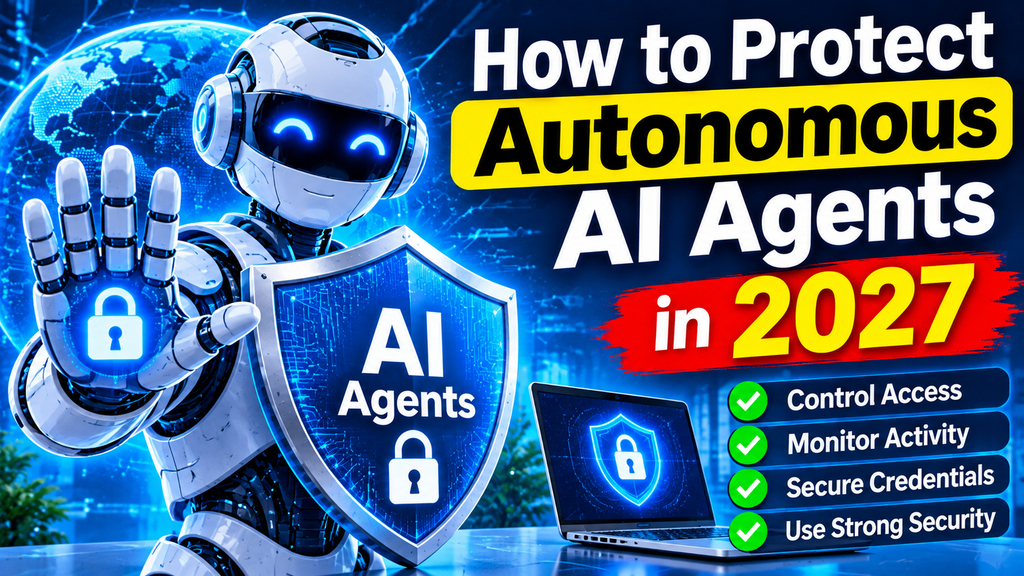
Businesses do not need to stop using autonomous AI systems to improve security. Instead, they should build appropriate protection into their AI infrastructure.
Here are eight practical security measures.
1. Give Every AI Agent a Unique Identity
Each AI agent should have a clearly defined digital identity.
This makes it easier to identify which agent is accessing a system or performing an action.
Organizations should avoid allowing multiple agents to share unrestricted credentials.
2. Apply Role-Based Access Control
Role-based access control limits what an agent can do based on its assigned responsibilities.
For example, a customer support agent may need permission to view customer requests but should not have access to financial administration systems.
3. Use Multi-Factor Authentication
Multi-factor authentication adds another layer of protection to important accounts and administrative systems.
Organizations should also use secure authentication methods for machine identities and service accounts where supported.
4. Monitor AI Agent Activities
Businesses should maintain records of important agent activities.
Monitoring can help security teams identify unusual access patterns, unexpected actions, and possible security incidents.
5. Secure API Keys and Credentials
API keys and authentication credentials should be stored securely.
They should not be included directly in public source code, prompts, or unsecured configuration files.
Organizations should rotate credentials and revoke access when an agent no longer needs it.
6. Require Human Approval for Sensitive Actions
Some AI activities should not happen without human supervision.
Examples include:
- Approving large financial transactions.
- Deleting important business records.
- Changing security configurations.
- Accessing highly confidential information.
- Sending sensitive external communications.
Human approval helps reduce the impact of incorrect or unauthorized automated decisions.
7. Test AI Systems Before Deployment
Organizations should test AI agents against different security scenarios before allowing them to operate in production environments.
Testing should include prompt injection attempts, unauthorized access requests, incorrect permissions, and unexpected tool behavior.
8. Keep AI Software Updated
AI platforms, connected applications, and security tools should be maintained with appropriate updates.
Regular security reviews can help organizations identify weaknesses before they become serious problems.
AI Agent Security vs Traditional Cybersecurity
Traditional cybersecurity mainly focuses on protecting networks, devices, applications, accounts, and information.
AI agent security adds another important layer: controlling autonomous software that can make decisions and take actions.
| Traditional Cybersecurity | AI Agent Security |
|---|---|
| Protects user accounts | Protects human and machine identities |
| Controls application access | Controls agent permissions and actions |
| Monitors network activity | Monitors autonomous agent behavior |
| Protects stored information | Protects data used by AI agents |
| Detects unauthorized access | Detects unsafe agent actions and misuse |
Both approaches are necessary because autonomous AI systems operate within existing digital environments.
What Is AI Agent Identity?
AI agent identity is a way to establish and manage the identity of an autonomous AI system.
It helps organizations understand which agent is operating, what permissions it has, and which actions it is authorized to perform.
For example, a business may operate separate agents for customer support, software development, and financial reporting.
Each agent should have its own identity and clearly defined permissions.
Gartner has highlighted AI agent identity as one of its strategic technology trends for 2027, emphasizing the importance of managing machine identities and access privileges.
This development could become increasingly important as companies deploy more autonomous systems.
The Future of Autonomous AI Security
In 2027 and beyond, cybersecurity is likely to become more closely connected with AI identity, automation, and governance.
Businesses will need to consider not only how AI agents perform tasks but also how they access information and interact with other systems.
Several areas may receive increasing attention:
- AI agent identity management.
- Automated security monitoring.
- Stronger access control systems.
- AI governance and accountability.
- Secure connections between autonomous agents.
- Human supervision of high-impact AI decisions.
These developments will help organizations use autonomous technology more responsibly.
However, AI security will remain an ongoing challenge as new technologies and attack methods continue to evolve.
Conclusion
AI agent security is becoming an important technology priority as autonomous systems take on more responsibilities in business and everyday digital operations.
Although AI agents can improve productivity and automate complex tasks, they also introduce risks involving unauthorized access, prompt injection, identity theft, and data exposure.
Businesses can reduce these risks by assigning unique agent identities, limiting permissions, securing credentials, monitoring activities, and requiring human approval for sensitive actions.
As organizations move toward more autonomous technology in 2027, security must become a fundamental part of AI development and deployment.
Frequently Asked Questions(FAQs)
1. What is AI agent security?
AI agent security involves protecting autonomous AI systems from unauthorized access, data exposure, malicious instructions, and harmful automated actions.
2. Why is AI agent security important in 2027?
As more businesses adopt autonomous AI systems, controlling their identities, permissions, and activities becomes increasingly important.
3. What are the biggest AI agent security risks?
Major risks include prompt injection, unauthorized data access, identity theft, insecure API connections, excessive permissions, and data leakage.
4. What is AI agent identity?
AI agent identity is a digital identity used to identify an autonomous AI system and manage its permissions and access to connected services.
5. Can AI agents be hacked?
Yes. AI agents can be exposed to security vulnerabilities, stolen credentials, malicious instructions, and weaknesses in connected applications.
6. How can businesses protect AI agents?
Businesses can use unique agent identities, role-based access control, secure credentials, activity monitoring, regular testing, and human approval for sensitive operations.
7. Will AI agents replace traditional cybersecurity?
No. AI agent security complements traditional cybersecurity by addressing risks associated with autonomous software and machine identities.
8. What is the future of AI cybersecurity?
Future AI cybersecurity will likely place greater emphasis on identity management, automated monitoring, secure AI infrastructure, and responsible autonomous decision-making.
AI Agent Security, AI Agent Security 2027, AI Agent Cybersecurity, Autonomous AI Security, AI Agent Identity Management, AI Agent Security Risks, AI Agent Protection, AI Agent Access Control, AI Security Threats, Prompt Injection Attacks, AI Data Protection, Secure AI Systems, AI Cybersecurity Trends 2027, AI Automation Security, Future of AI Security
AI Agent Security, AI Agent Security 2027, AI Cybersecurity, Autonomous AI, AI Agent Identity, Prompt Injection, AI Security Risks, Data Protection, Artificial Intelligence, Cybersecurity Trends 2027