Introduction
Wireless internet has become an essential part of modern life. From smartphones and laptops to smart homes, online gaming, video streaming, and business operations, people depend on fast and reliable Wi-Fi connections every day.
Over the years, Wi-Fi technology has continued to improve. Wi-Fi 5, Wi-Fi 6, Wi-Fi 6E, and Wi-Fi 7 have introduced better performance, higher data rates, and improved connectivity. Now, the wireless industry is preparing for another major development: Wi-Fi 8 technology.
Wi-Fi 8, based on the IEEE 802.11bn standard, is designed to improve wireless reliability, connection stability, network efficiency, and performance in demanding environments.
Unlike previous generations that placed significant emphasis on increasing maximum speed, Wi-Fi 8 focuses on delivering a more consistent internet experience, even when multiple devices are connected or users move between wireless access points.
In this article, we explore what Wi-Fi 8 is, how it works, its expected features, potential benefits, and how it could transform wireless connectivity in the coming years.
What Is Wi-Fi 8 Technology?
Wi-Fi 8 is the next generation of wireless networking technology, developed around the IEEE 802.11bn standard. Its technical focus is known as Ultra High Reliability (UHR).
The primary goal of Wi-Fi 8 is to make wireless connections more dependable, responsive, and efficient.
In everyday situations, download speed alone does not determine internet performance. Network congestion, interference, signal strength, latency, and connection interruptions can all affect the user experience.
Wi-Fi 8 aims to address these challenges by improving wireless communication and coordination between access points.
For example, someone attending an online meeting while moving between rooms may experience fewer interruptions if the network and compatible devices support improved roaming and connection management.
The technology is particularly relevant for smart homes, offices, industrial environments, and other locations where many connected devices operate simultaneously.
1. Improved Wireless Connection Reliability
One of the most important goals of Wi-Fi 8 is improving connection reliability.
Traditional wireless networks can experience interruptions when multiple devices compete for available bandwidth or when nearby networks create interference.
Wi-Fi 8 is being designed to improve how wireless devices communicate under challenging network conditions.
Expected improvements include:
- More consistent wireless connections.
- Better handling of network congestion.
- Reduced packet loss.
- Improved communication between access points.
- More stable performance in busy environments.
These improvements could be especially useful for businesses, remote workers, and households with numerous connected devices.
2. Better Multi-Access Point Coordination
Modern homes and offices often use multiple wireless access points to provide wider internet coverage.
However, poorly coordinated access points can create interference and reduce network efficiency.
Wi-Fi 8 introduces advanced multi-access point coordination techniques intended to help nearby access points work together more effectively.
Instead of operating independently, compatible access points can coordinate certain wireless activities to improve network performance.
Potential advantages include:
- Reduced interference between access points.
- More efficient use of wireless channels.
- Better network performance in crowded buildings.
- Improved connectivity across larger spaces.
- More consistent wireless coverage.
This development could be valuable in apartment buildings, shopping centers, offices, hotels, and other locations with dense wireless networks.
3. Lower Latency for Real-Time Applications
Latency refers to the time it takes for data to travel between a device and a network destination.
Low latency is important for applications that require quick responses, including online gaming, video conferencing, remote collaboration, and industrial automation.
Wi-Fi 8 aims to improve latency consistency, particularly when networks are busy.
This could help reduce delays and make real-time applications more responsive.
Potential use cases include:
- Competitive online gaming.
- Cloud-based applications.
- High-quality video conferencing.
- Augmented and virtual reality.
- Industrial communication systems.
However, actual latency will still depend on the internet connection, router capabilities, network configuration, and the servers being accessed.
4. Improved Coverage and Performance at Longer Distances
Wireless signals can become weaker as users move farther away from a router or encounter walls and other physical obstacles.
This can result in slower connections, unstable performance, and interrupted online activities.
Wi-Fi 8 is expected to introduce improvements that help maintain more consistent communication under challenging signal conditions.
Its development includes enhanced long-range capabilities and other physical-layer improvements.
These features could help improve connectivity in:
- Large homes.
- Multi-floor buildings.
- Offices and commercial spaces.
- Warehouses.
- Industrial environments.
It is important to understand that Wi-Fi 8 will not eliminate all coverage problems. Building materials, router placement, interference, and access point design will continue to affect wireless performance.
5. More Efficient Network Performance
As the number of connected devices increases, wireless networks must manage available resources more intelligently.
Smartphones, laptops, televisions, security cameras, smart speakers, and connected appliances all compete for network resources.
Wi-Fi 8 is designed to improve wireless resource management and make better use of available spectrum.
Advanced techniques such as dynamic subband operation and non-primary channel access are among the technologies being developed for the standard.
These improvements could help wireless networks operate more efficiently, particularly in environments with heavy device activity.
For users, the goal is a more consistent connection rather than simply a higher theoretical speed.
6. Better Support for Smart Homes and IoT Devices
Smart home technology continues to expand across the United States and other markets.
Consumers increasingly use connected thermostats, security cameras, smart lighting, door locks, televisions, and voice assistants.
As these devices become more advanced, reliable wireless communication becomes increasingly important.
Wi-Fi 8 could help support future smart home environments by improving connection stability and network efficiency.
Possible applications include:
- Smart home security systems.
- Connected home appliances.
- Intelligent lighting systems.
- Smart entertainment devices.
- Home automation platforms.
For example, a smart home with multiple cameras and connected appliances could benefit from more reliable communication between wireless devices and access points.
7. Wi-Fi 8 and the Future of Business Connectivity
Businesses depend on wireless networks for communication, collaboration, customer services, and daily operations.
In large offices, hotels, hospitals, warehouses, and educational institutions, hundreds or even thousands of devices may connect to the same wireless infrastructure.
Wi-Fi 8 could improve these environments through better network coordination, reliability, and latency management.
Some potential business applications include:
Remote Work: More consistent wireless connections could support video meetings, cloud applications, and online collaboration.
Healthcare: Reliable wireless communication could support connected medical equipment and hospital information systems.
Manufacturing: Industrial environments could benefit from improved communication between connected equipment and monitoring systems.
Education: Schools and universities could support large numbers of connected students and digital learning devices.
Retail: Stores could use connected inventory systems, payment terminals, and smart monitoring devices.
These are potential applications, not guarantees. Critical systems will still require appropriate network planning, security, and backup connectivity.
Wi-Fi 8 vs Wi-Fi 7: What Is the Difference?
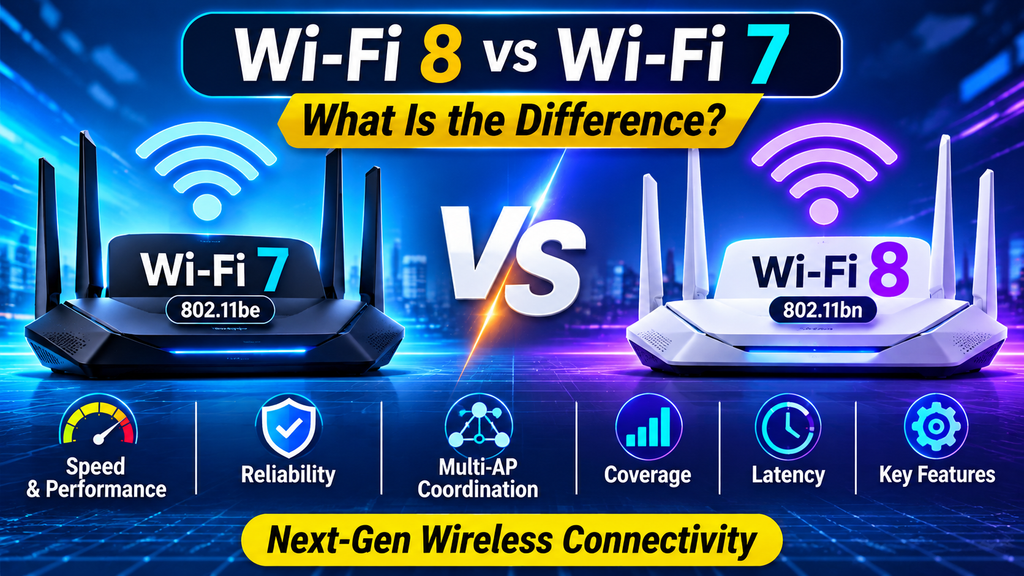
Wi-Fi 7 introduced major improvements in wireless performance, including support for wider channels, Multi-Link Operation, and higher data rates.
Wi-Fi 8 takes a different approach by focusing more strongly on reliability and consistent performance.
Here is a simplified comparison:
| Feature | Wi-Fi 7 | Wi-Fi 8 |
|---|---|---|
| IEEE standard | 802.11be | 802.11bn |
| Main focus | Extremely high throughput | Ultra High Reliability |
| Network performance | High-speed connectivity | More consistent connectivity |
| Latency | Improved latency capabilities | Better latency consistency goals |
| Multi-AP coordination | More limited | Enhanced coordination capabilities |
| Congestion management | Advanced | Further improvements expected |
| Development status | Established standard | Under development |
Wi-Fi 8 is not simply about replacing Wi-Fi 7 with a faster version. Its main objective is improving the quality and dependability of wireless connections.
When Will Wi-Fi 8 Be Available?
Wi-Fi 8 is still progressing through the IEEE standards development process.
As of November 2026, IEEE 802.11bn has advanced through working-group draft reviews and balloting, but the final standard has not yet been published.
The official IEEE project timeline currently indicates further development and approval milestones extending into 2028.
Compatible hardware may begin appearing before final standard publication, but commercial availability and certification timelines can change.
Consumers should therefore treat 2027 as a potential early hardware-development period rather than a guaranteed year for widespread Wi-Fi 8 adoption.
Will You Need a New Router for Wi-Fi 8?
Yes. To use Wi-Fi 8 features, consumers will need compatible Wi-Fi 8 networking equipment and compatible client devices.
An existing Wi-Fi 6 or Wi-Fi 7 router will not become a Wi-Fi 8 router through a simple software update.
Before purchasing new equipment, consumers should consider:
- Whether their devices support the new standard.
- Their actual internet speed requirements.
- The size of their home or office.
- Router compatibility.
- Network security features.
- The cost of upgrading existing equipment.
There is no immediate need for most consumers to replace a working Wi-Fi 7 router simply because Wi-Fi 8 is approaching.
Challenges and Limitations of Wi-Fi 8
Although Wi-Fi 8 has significant potential, several challenges could affect its adoption.
1. Hardware Costs: New routers and compatible devices may initially be expensive.
2. Device Compatibility: Older smartphones, laptops, and smart home devices will not automatically support Wi-Fi 8 features.
3. Standardization: The IEEE specification is still under development, so technical details and timelines may change.
4. Internet Provider Limitations: A more advanced router cannot automatically increase the speed of an internet subscription.
5. Network Infrastructure: Achieving the best performance may require properly designed access point placement and upgraded networking equipment.
These factors will influence how quickly Wi-Fi 8 becomes widely available.
Conclusion
Wi-Fi 8 represents an important step in the evolution of wireless networking. Based on IEEE 802.11bn, this next-generation technology is being developed to improve reliability, reduce inconsistent latency, manage interference, and deliver better wireless performance in demanding environments.
From smart homes and online gaming to healthcare, business networks, and industrial automation, reliable wireless connectivity will become increasingly important.
Although Wi-Fi 8 is not yet a finalized standard, its development highlights a major direction for the future of networking: better connections, fewer interruptions, and more dependable performance.
As the technology continues to mature, Wi-Fi 8 could help build the foundation for a more connected digital world.
Frequently Asked Questions (FAQs)
1. What is Wi-Fi 8 technology?
Wi-Fi 8 is the next generation of wireless networking technology based on IEEE 802.11bn. It focuses on ultra-high reliability, improved connectivity, and more consistent network performance.
2. Is Wi-Fi 8 faster than Wi-Fi 7?
Wi-Fi 8 primarily focuses on reliability and consistent performance rather than simply increasing maximum theoretical speed. Its real-world benefits will depend on the final specification and compatible hardware.
3. When will Wi-Fi 8 be released?
The IEEE 802.11bn standard is still under development. Its official project timeline includes further milestones extending into 2028, while compatible hardware could appear earlier.
4. Will Wi-Fi 8 work with older devices?
Wi-Fi 8 routers are expected to support legacy Wi-Fi compatibility, depending on the final implementation. However, older devices will not receive the new Wi-Fi 8 features.
5. What is the main benefit of Wi-Fi 8?
Its main expected benefit is ultra-high reliability, including more stable connections, better interference management, and improved performance in crowded wireless environments.
6. Do I need a new router for Wi-Fi 8?
Yes. You will need a compatible Wi-Fi 8 router or access point to use Wi-Fi 8 features. Compatible client devices will also be required.
7. Is Wi-Fi 8 useful for gaming?
Wi-Fi 8 could benefit online gaming through improved latency consistency and more reliable connections. However, gaming performance will also depend on internet service quality and server distance.
Wi-Fi 8 Technology, Wi-Fi 8 Features, Wi-Fi 8 Release Date, Wi-Fi 8 vs Wi-Fi 7, Next Generation Wi-Fi, Wireless Network Technology, IEEE 802.11bn, Future of Wi-Fi, Wi-Fi 8 Benefits, Advanced Wireless Connectivity
Wi-Fi 8, Wi-Fi 7, Wireless Technology, Internet Technology, Networking, Future Technology, Technology Trends, Smart Home, Wi-Fi Networks, Next Generation Networks