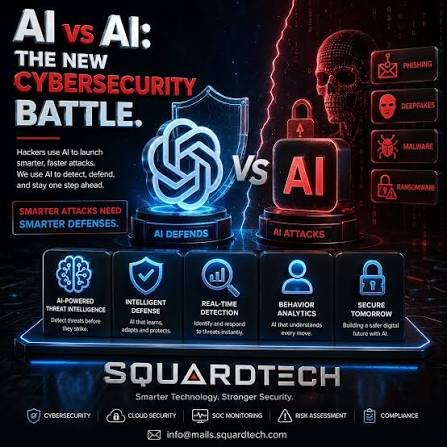
Artificial intelligence has transformed the digital world faster than many organizations expected. In 2026, AI is no longer simply a tool for automation, productivity, and innovation—it has also become an important factor in the cybersecurity landscape.
As businesses adopt AI-powered systems, cybercriminals are finding new ways to use the same technology against them. This has created a new digital arms race: AI vs. Cybersecurity.
The Rise of AI-Powered Cuber Attacks
Traditional cyberattack s often required significant time, technical knowledge, and manual effort. AI is changing that equation.
Attackers can use AI to analyze large amounts of information, identify potential weaknesses, automate repetitive tasks, and create more convincing social-engineering campaigns. This can make certain attacks faster, more salable, and harder to detect.
Phishing is one example. Instead of sending generic messages containing obvious mistakes, attackers can use AI to create highly personalized communications that appear more realistic. Similar techniques can be used to imitate writing styles, automate conversations, and increase the volume of malicious campaigns.
AI Is Also Becoming a Defensive Weapon
The story is not entirely negative. The same technology that creates new risks can also strengthen cybersecurity.
Security teams can use AI to analyze enormous volumes of security logs, detect unusual behavior, identify suspicious patterns, and prioritize potential threats. AI can help organizations respond to incidents more quickly by connecting signals that might otherwise be missed by human analysts.
This is particularly important because modern organizations generate huge amounts of security data every day. Human teams cannot manually examine everything, making intelligent automation increasingly valuable.
Deepfakes and Identity-Based Threats
One of the emerging challenges is the growing sophistication of synthetic media.
AI can generate convincing text, audio, images, and video. This creates new opportunities for impersonation and fraud. An attacker may attempt to convince an employee that a request is coming from a manager, executive, customer, or business partner.
As these technologies improve, organizations will need to rely less on appearance or voice alone when verifying identity. Strong authentication and independent verification will become increasingly important.
The Human Factor Remains Critical
Despite advances in AI, people remain one of the most important elements of cybersecurity.
Employees may receive convincing messages, encounter manipulated content, or make mistakes under pressure. Technology can reduce these risks, but it cannot completely eliminate them.
Organizations should therefore invest in security awareness training, clear reporting procedures, strong authentication, and a culture where employees feel comfortable questioning unusual requests.
How Organizations Can Prepare
Preparing for AI-powered threats requires more than purchasing another security product. Organizations need a comprehensive security strategy.
Key priorities include:
- Adopting strong identity and access controls
- Using multi-factor authentication
- Monitoring networks and systems for unusual activity
- Regularly updating software and security systems
- Training employees to recognize sophisticated social-engineering attempts
- Testing incident-response plans
- Protecting sensitive data used by AI systems
- Establishing clear policies for responsible AI use
Organizations should also understand how their own employees are using AI tools. Uncontrolled use of AI applications can create privacy, data-leakage, and compliance risks.
The AI Cybersecurity Arms Race
The cybersecurity landscape of 2026 is increasingly defined by speed.
Attackers can automate parts of their operations, while defenders can use AI to analyze threats and respond faster. This creates an ongoing arms race in which both sides continuously adapt.
However, relying entirely on AI would be a mistake. AI systems themselves can make errors, produce inaccurate results, or become targets for manipulation. Human oversight, security controls, and well-designed processes remain essential.
Are We Ready?
The answer is complicated.
Many organizations are better prepared than they were a few years ago, but the threat landscape is evolving rapidly. Security strategies designed for yesterday’s attacks may not be sufficient for tomorrow’s AI-assisted threats.
The goal should not be to stop using AI. Instead, organizations need to learn how to use AI securely while preparing for the ways adversaries may exploit it.
The future of cybersecurity will not simply be about AI fighting AI. It will be about combining artificial intelligence with skilled security professionals, strong policies, resilient infrastructure, and informed users.
Conclusion
AI is changing cybersecurity on both sides of the battlefield. It can make attacks more sophisticated, but it can also give defenders powerful tools for detection, analysis, and response.
In 2026, the organizations most likely to succeed will be those that treat AI security as an ongoing process rather than a one-time project.
The question is no longer whether AI will influence cybersecurity. It already does. The real question is whether organizations can adapt quickly enough to stay ahead.